
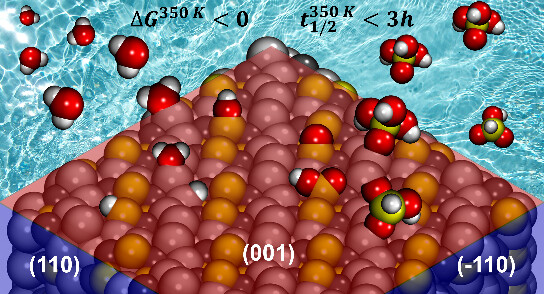
Computational kinetic studies reveal the water corrosion of meteoritic schreibersite (Fe2NiP) to phosphorus-oxygen compounds, a key prebiotic process, can occur on a scale of a few hours at 350 K.
Among the biogenic macroelements, phosphorus is the one bringing the most fascinating and unsolved mysteries concerning its prebiotic history. It possibly landed on Earth as a metal phosphide (schreibersite, (Fe,Ni)3P), throughout the Heavy Meteor Bombardment during the Archean Era. Its subsequent corrosion by water led to P-oxygenated compounds, which are the subject of this kinetic computational study, which complements our previous thermodynamic characterization. The reaction was studied at the periodic DFT level, simulating the water corrosion reaction on the reactive Fe2NiP schreibersite (001) surface. Results show that the time scale of the reaction at 350 K is a few hours.
This work has been published in ACS Earth and Space Chemistry.
Link to the article in ACS Earth Space Chem.: https://pubs.acs.org/doi/10.1021/acsearthspacechem.4c00321
Link to the article as green open access: https://arxiv.org/abs/2502.19235