
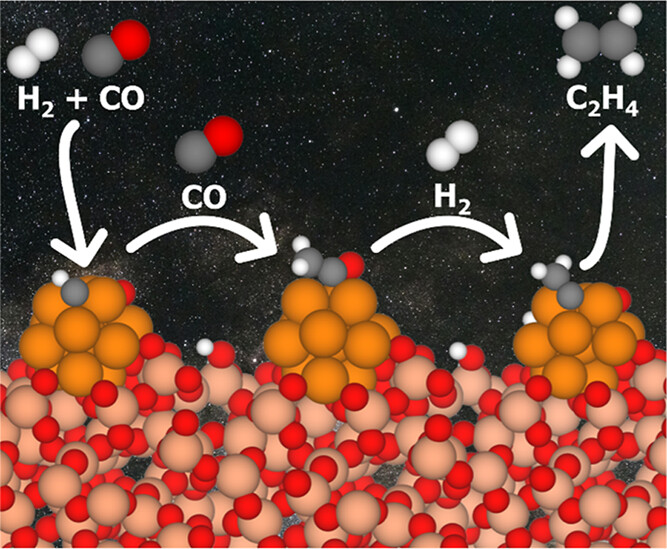
A realistic computational model demonstrates that silica-supported iron nanoclusters can act as effective astrocatalysts for Fischer–Tropsch-type reactions in space, enabling the formation of methanol, ethanol, and hydrocarbons at temperatures above 100 K by facilitating CO dissociation with the aid of hydrogen.
Catalytic processes are fundamental not only to terrestrial chemistry (e.g., in the synthesis of fuels, chemicals, and pharmaceuticals) but also to extraterrestrial chemistry, contributing to chemical reactions occurring in various astrophysical environments. In space, gas-phase reactions are limited due to sparse energy sources and the absence of a medium for energy dissipation, making heterogeneous catalysis on cosmic dust grains essential for driving chemical transformations. Iron nanoclusters (FeNCs) embedded on these grains present intriguing catalytic properties, especially for Fischer–Tropsch-type (FTT) reactions that synthesize interstellar organic compounds. This study investigates the formation of short-chain alcohols (CH3OH and CH3CH2OH) and hydrocarbons (CH4, CH2CH2 and CH3CH3) through a FTT mechanism using as astrocatalyst a realistic model of an Fe13 nanocluster supported on a silica (SiO2) surface (Fe13@SiO2) by characterizing the potential energy surfaces (PESs) and performing kinetics calculations. Comprehensive PESs grounded on density functional theory (DFT) reveal that direct CO dissociation on Fe13@SiO2 (required to form CH3CH2OH and CH4) is energetically unfavorable, but subsequent H2 addition facilitates CO bond cleavage, thus competing with the formation of CH3OH. Moreover, kinetic analysis indicates that C–O dissociation is more favorable than CH3OH synthesis, enabling chain-growing-based processes. Kinetics also predicts that the temperatures at which the FTT reactions can operate (i.e., above 100 K) are those available in protostellar regions and in evolved stages during a Solar-type planetary system formation (e.g., protoplanetary disks and primitive planetary environments).These findings offer a new proof on the feasibility of Astrocatalysis (namely, true chemical catalysis in astrophysical environments), in this case exerted by FeNCs, which partly alleviate stringent conditions required for FT on Earth, this way proposing a potential FTT-supported catalysis under milder conditions in astrochemical contexts.
This work has been published in The Journal of Physical Chemistry C
Link to the article as gold open access: https://doi.org/10.1021/acs.jpcc.5c01472