
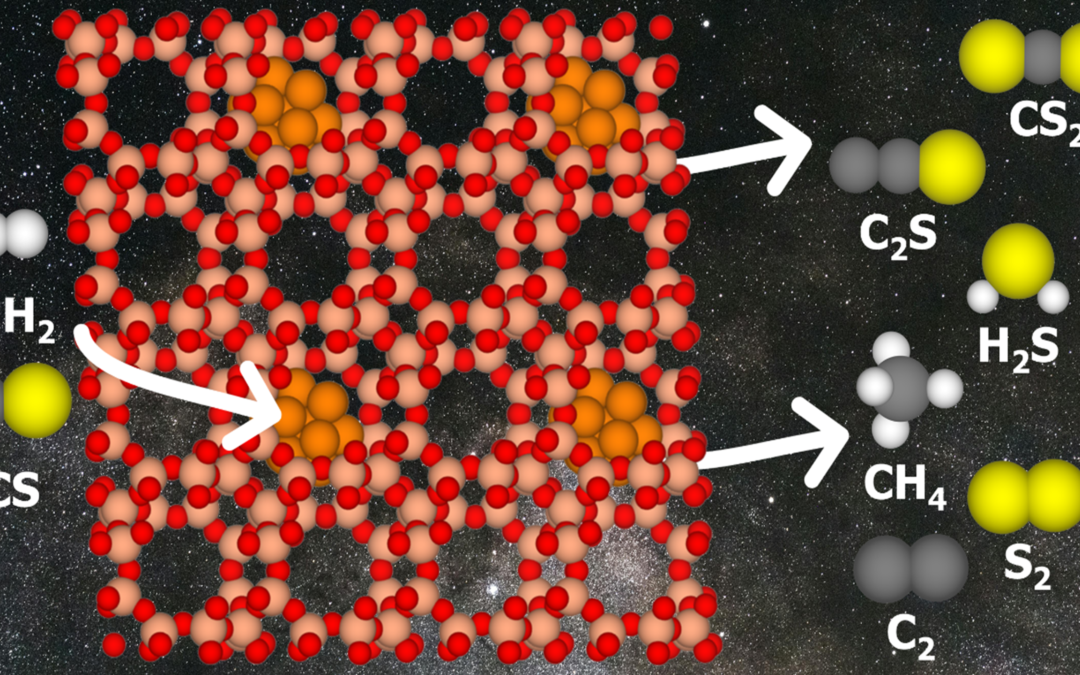
Confining an Fe₁₃ nanocluster within a chabazite zeolite shifts the chemoselectivity of CS + H₂ from hydrogenation to C–S bond cleavage (forming H₂S and CH₄ instead of H₂CS), suggesting zeolites as nanoreactors that could help address the interstellar missing sulfur problem.
Zeolites are plausible nanoreactors in astrochemical environments, where their internal porosity and ability to host transition metals modulate surface reactivity under near-vacuum conditions. We investigate the confined chemistry of carbon monosulfide (CS) and hydrogen (H2) on an Fe13 nanocluster embedded in chabazite (Fe13@CHA) using density functional theory and microkinetic modeling. Motivated by the long-standing “missing sulfur” problem and the relevance of thioformaldehyde (H2CS), we use CS + H2 as a test reaction. On Fe13@CHA, H2 dissociates and CS adsorption strongly polarizes the CS bond; confinement tilts the competition between pathways so that CS bond scission dominates over H2 addition toward H2CS. The resulting C and S adatoms are trapped and funnel reactivity toward H2S and CH4 via sequential hydrogenation. Calculations on an open Fe13@SiO2 surface show that, in the absence of confinement, CS hydrogenation to HCS is preferred, confirming that the shift in chemoselectivity is a genuine confinement effect. Insertion of a second CS molecule (without H2) enables the formation of CS2, C2S, and C2 species, with barriers that favor C–C over S–S coupling. Kinetic analysis indicates that these processes become efficient at mid-to-high temperatures, identifying inner protoplanetary regions as promising environments where zeolitic grains sequester sulfur and reshape CS-based chemistry.
This work has been published in Small Structures.
Link to the article in Small Structures as gold open access: https://doi.org/10.1002/sstr.202500909