
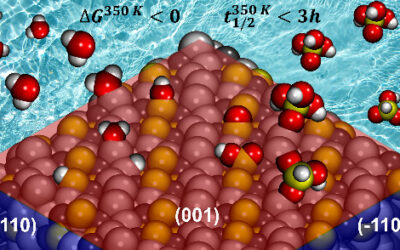
The Prebiotic Pathway from P-Bearing Iron Meteorites to Phosphates by DFT Modeling
Computational kinetic studies reveal the water corrosion of meteoritic schreibersite (Fe2NiP) to phosphorus-oxygen compounds, a key prebiotic process, can occur on a scale of a few hours at 350 K.
leer más…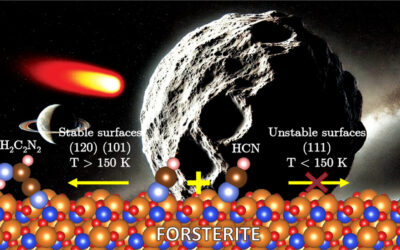
Exploring Forsterite Surface Catalysis in HCN Polymerization: Computational Insights for Astrobiology and Prebiotic Chemistry
According to quantum mechanical simulations, the less reactive (120) and (101) surfaces of the cosmic silicate forsterite effectively catalyze the formation of prebiotic iminoacetonitrile from hydrogen cyanide by enabling its deprotonation while still allowing reactant diffusion.
leer más…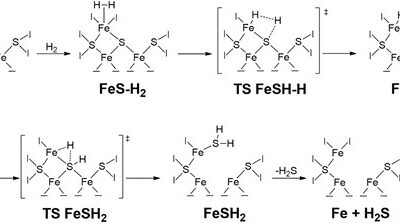
Reactivity of chondritic meteorites under H2-rich atmospheres: Formation of H2S
Chondritic meteorites, as analogs for early Solar System dust, can catalytically reduce FeS to H₂S and metallic Fe under hydrogen-rich atmospheres, with implications for early planetary chemistry.
leer más…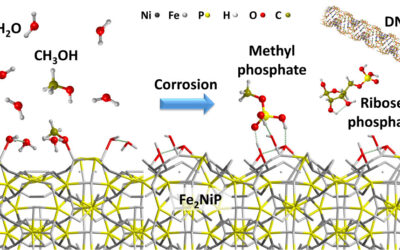
Atomistic Insights on Prebiotic Phosphorylation of Methanol from Schreibersite (Fe2NiP) Corrosion: Ab Initio Computational Study
Through density functional theory calculations, the mineral Schreibersite from meteorites can thermodynamically and kinetically promote the deprotonation of methanol and water, leading to its own corrosion and the formation of prebiotically significant phosphate and methyl phosphate.
leer más…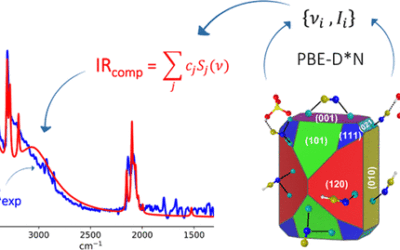
Unraveling the Interface Chemistry between HCN and Cosmic Silicates by the Interplay of Infrared Spectroscopy and Quantum Chemical Modeling
Infrared spectra of HCN/forsterite interfaces are deconvoluted by means of nonlinear best fits between experimental and computed spectra. This synergistic approach allows a reliable spectroscopic interpretation of gas-surface systems as a powerful tool to study heterogeneous catalysis and grain-surface astrochemistry.
leer más…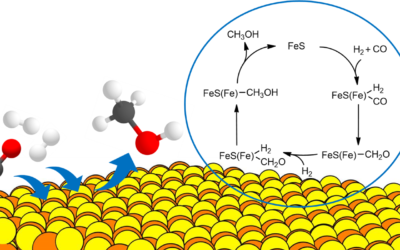
Formation of Methanol via Fischer-Tropsch Catalysis by Cosmic Iron Sulphide
In the extreme conditions of the interstellar medium, cosmic FeS surfaces act as unexpected chemical catalysts, driving the elusive synthesis of methanol and shedding light on its mysterious abundance across the cosmos.
leer más…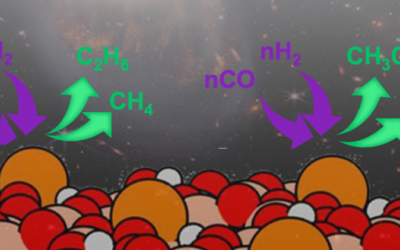
Single-atom catalysis in space II. Ketene–acetaldehyde–ethanol and methane synthesis via Fischer-Tropsch chain growth.
Here is the second chapter of true catalysis in space! Simulations indicate that ethanol and FT by-products can form through Fischer-Tropsch synthesis in astrophysical environments by single atom Fe on silica. Fundamental and aplied knowledge at once!
leer más…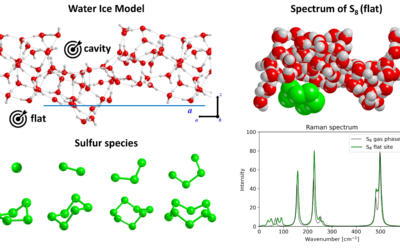
Binding Energies and Vibrational Spectral Features of Sn Species on Amorphous Water-ice Mantles: A Quantum Mechanical Study
Pure sulfur is known to form several allotropes, which have lately been proposed as possible sulfur reservoir in cold clouds, where gas-phase sulfur depletion is observed. Indeed, larger species show stronger interactions with the water ice mantles of dust grains. However, their spectroscopic features are more suitable to their detection in terrestrial laboratories rather than in the interstellar medium.
(más…)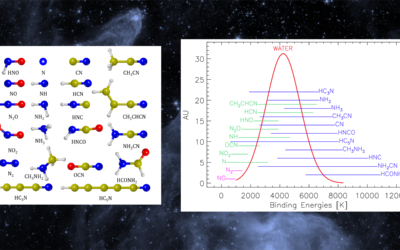
Binding Energies of N-bearing Species on Interstellar Water Ice Mantles by Quantum Chemical Calculations
The binding energies of 21 N-bearing interstellar species on water ice surfaces have been computed to understand how these species are trapped in ices and their faith in protoplanetary disks by comparing the values with the water snow line
leer más…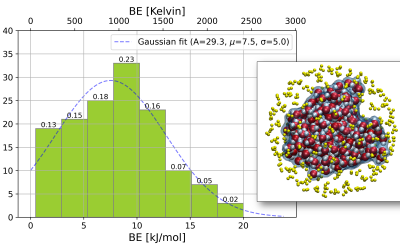
The binding energy distribution of H2S: why it is not the major sulphur reservoir of the interstellar ices
Computations on the binding energy of H2S on interstellar water ices allow us to understand why H2S is not found as an icy species and yes as a gaseous one. The reason? The weak H2S/H2O ice interactions between the two partners!
leer más…