
A multiscale computational framework for H₂S diffusion on amorphous solid water reveals negligible thermal diffusion below 20 K and no universal scaling between binding energy and diffusion barriers, challenging current assumptions in astrochemical models.
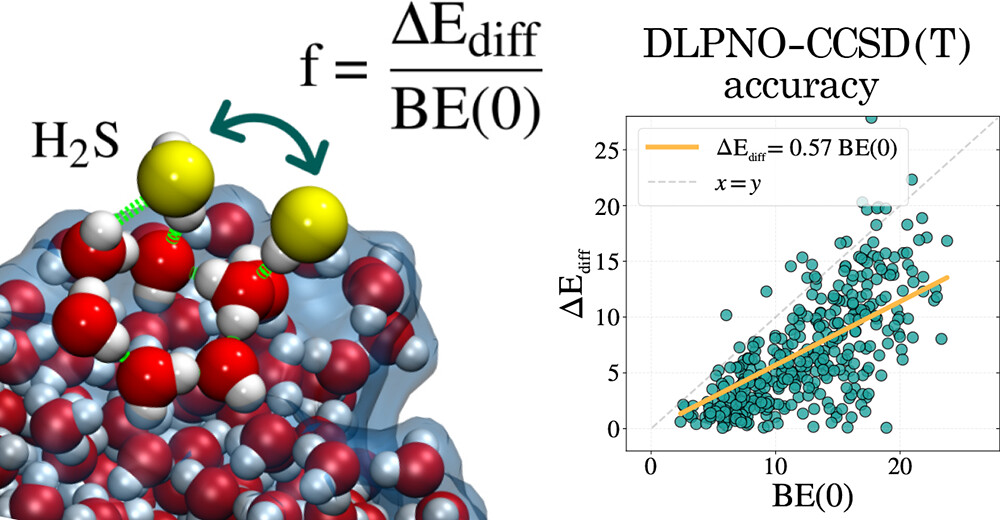
Understanding diffusion on interstellar ices is key to modeling the chemical evolution of cold molecular clouds, where low temperatures severely limit molecular mobility. In this study, we introduce a robust and fully automated multiscale computational framework to quantify diffusion processes of adsorbates at the surface of amorphous solid water (ASW). Using H2S as a test case, whose binding sites were previously studied at the ab initio level, we constructed a detailed network of 141 adsorption sites connected by over 270 transition states. All density functional energetics were benchmarked against DLPNO–CCSD(T), achieving chemical accuracy in the description of diffusion barriers, which span from 0.1 to 27 kJ mol–1 with a median value of 5.4 kJ mol–1. An off-lattice kinetic Monte Carlo (kMC) model adopting both the ab initio diffusion barriers and binding energies for the desorption processes was carried out to compute temperature-dependent diffusion coefficients and to reconstruct the temperature-programmed desorption (TPD) curve. Our simulations reveal that thermal diffusion of H2S is negligible below 20 K, with diffusion coefficients as low as 10–48 cm2 s–1 at 10 K, thus excluding Langmuir–Hinshelwood surface encounters under typical dense cloud conditions. Moreover, under submonolayer conditions, diffusion was found to have negligible influence on the reconstructed TPD peak position. Furthermore, our results demonstrate that a universal scaling factor f to guess the diffusion barriers (ΔEdiff) from the sole knowledge of BE: f = ΔEdiff/BE does not apply as it exhibits wide variability across the sampled configurations. These findings highlight the need for incorporating statistically meaningful distributions of binding energies and diffusion barriers in astrochemical models to more accurately capture diffusion and surface reactivity on interstellar ices.
This work has been published in ACS Earth and Space Chemistry.
Link to the article in ACS Earth and Space Chemistry as gold open access: https://doi.org/10.1021/acsearthspacechem.5c00208