
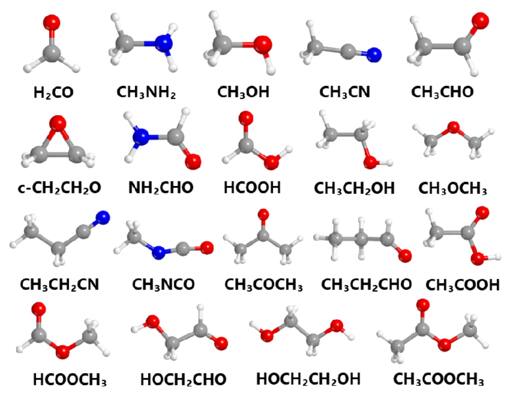
Reliable binding energies for 19 interstellar complex organic molecules on realistic water ice surfaces, calculated via a quantum chemical approach, are crucial for accurately modeling their snow lines and solid-to-gas transitions in cosmic regions like hot cores and protoplanetary disks.
Interstellar dust grains are enveloped by ices of frozen molecules in cold, dense regions of the interstellar medium (ISM), which are also observed in the gas phase. Whether a species is in the solid or gaseous state is governed by its binding energy (BE) on the grains. Hence, BEs are crucial in the solid-to-gas transition and are key input parameters for astrochemical models that simulate the physicochemical processes leading to the evolution of chemistry in the ISM. About 40% of the currently detected interstellar molecules belong to the category of interstellar complex organic molecules (iCOMs). This work aims to accurately evaluate the BEs of 19 iCOMs by means of quantum chemical calculations. Atomistic surface models simulating the structures of both crystalline and amorphous water ice were employed adopting a periodic approach, thereby accounting for the hydrogen bond (H-bond) cooperativity imparted by the extensive network present in the surfaces. A cost-effective but reliable procedure based on density functional theory was used to predict the structures of the adsorption complexes and calculate their BEs, which are mainly driven by H-bond and dispersion interactions, the latter presenting a fair contribution. A final discussion on the astrophysical implications of the computed BEs and the importance of obtaining reliable BEs on realistic interstellar ice surfaces in relation to the snow lines of iCOMs in hot cores/corinos and protoplanetary disks is provided.
This work has been published in The Astrophysical Journal.
Link to the article as open access in ApJ: https://iopscience.iop.org/article/10.3847/1538-4357/ae064a