
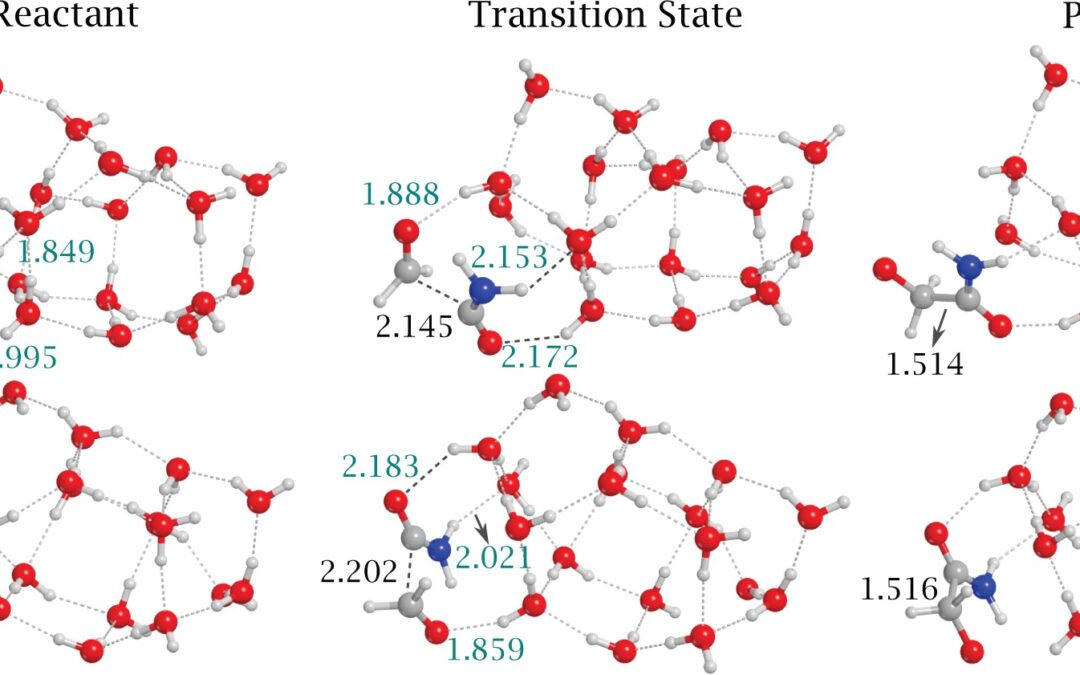
Computational studies reveal the formation of the detected interstellar molecule syn-glycolamide is feasible on icy grains through the low-barrier coupling of formamide and formaldehyde radicals followed by hydrogenation, with the anti-to-syn isomerization likely occurring upon desorption.
Syn-glycolamide, a glycine isomer, has recently been detected in the G+0.693-0.027 molecular cloud. Investigations into its formation in the interstellar medium could offer insights into synthetic routes leading to glycine in prebiotic environments. Quantum chemical simulations on glycolamide (NH2C(O)CH2OH) formation on interstellar ice mantles, mimicked by a water ice cluster model, are presented. In this paper, we modeled glycolamide synthesis considering a stepwise process: the coupling between formaldehyde (H2CO) and the radical of formamide (NH2CO•) occurs first, forming the glycolamide precursor NH2C(=O)CH2O•, which is then hydrogenated to give anti-glycolamide. We hypothesize that anti-to-syn interconversion occurs in conjunction with glycolamide desorption from the ice surface. The reaction barrier for NH2C(O)CH2O• formation varies from 9 to 26 kJ mol−1, depending on surface binding sites. Kinetic studies indicate that this reaction step is feasible in environments with a T > 35 K, until desorption of the reactants. The hydrogenation step leading to anti-glycolamide presents almost no energy barrier due to the easy H atom diffusion toward the NH2C(O)CH2O• intermediate. However, it competes with the extraction of an H atom from the formyl group of NH2C(O)CH2O•, which leads to formyl formamide, NH2C(O)CHO, and H2. Nonetheless, according to our results, anti-glycolamide formation is predicted to be the most favored reactive channel.
This work has been published in Astronomy and Astrophysics.
Link to the article in A&A as gold open access: https://www.aanda.org/articles/aa/full_html/2025/06/aa54330-25/aa54330-25.html