
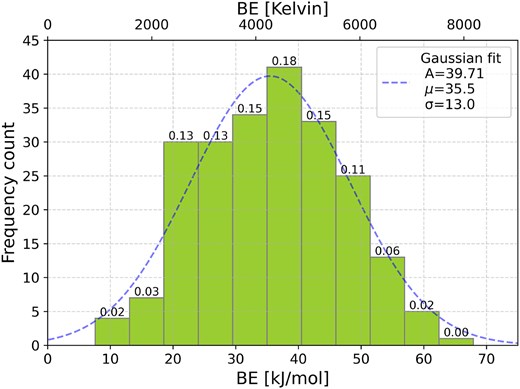
The binding energy distribution of methanol on interstellar ice grains, particularly a low-energy fraction (ca. 2%, 10 kJ mol⁻¹), enables its thermal desorption into the gas phase even in cold cosmic environments, resolving a long-standing observational challenge.
Methanol (CHOH) is the simplest and most abundant interstellar complex organic molecule (iCOM) observed in warm and cold environments. It is thought to be formed on the surfaces of dust grains and released into the gas-phase by thermal desorption of the ices in the warm regions where the dust temperature is high (100 K). However, the presence of gaseous methanol in cold environments represented a challenge since its detection, e.g. in cold molecular clouds, prestellar cores, and protoplanetary discs. The reason is that thermal desorption was thought to be completely inefficient in these conditions. In this work, we show that this is not the case. Specifically, we present new calculations of the binding energy (BE) distribution on an iced grain composed of 200 water molecules. On this grain we obtained 223 unique sites with different BE. We found that the methanol BE distribution is well reproduced by a Gaussian function with a mean of 35.5 kJ mol−1 (4255 K) and a standard deviation of 13.0 kJ mol−1 (1558 K). To facilitate the incorporation of our calculations into astrochemical models, we provide a table with the fraction of sites as a function of the BE and the corresponding prefactors. Comparison with published experimental BE values suggests that they are dominated by the larger BE sites. Finally, and most importantly, our calculations show that 2 per cent of the BEs are around 10 kJ mol−1 (1240 K), implying that thermal desorption from these sites may explain the presence of gaseous methanol in cold environments.
This work has been published in Monthly Notices of the Royal Astronomical Society.
Link to the article in MNRAS as gold open access: https://doi.org/10.1093/mnras/staf476