
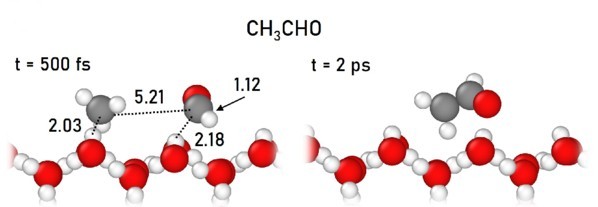
A computationally modeled non-diffusive three-body reaction on water ice—involving CO hydrogenation near a CH₃ radical—can efficiently form acetaldehyde at temperatures as low as 10 K, offering a potential route to interstellar complex organic molecules in cold environments without requiring radical diffusion.
The detection of interstellar complex organic molecules (iCOMs), such as acetaldehyde (CH3CHO), in cold astrophysical environments challenges standard grain-surface chemistry models, which rely on radical diffusion. At prestellar core temperatures (∼10 K), radical mobility is severely limited, making prevailing formation pathways inefficient. We here present a computational investigation of a nondiffusive, three-body reaction (3BR) mechanism for acetaldehyde formation on interstellar water ices. The mechanism involves the hydrogenation of CO to form HCO near a CH3 radical, enabling immediate reaction without requiring diffusion. We characterize the potential energy surface of the 3BR on a crystalline water ice model by identifying key minima and transition states, as well as evaluating competing pathways such as hydrogen abstraction. To assess the efficiency of this mechanism, ab initio molecular dynamics simulations were performed, with results indicating that CH3CHO can form efficiently at temperatures as low as 10 K. However, the formation of alternative products, such as CH4 and CO, or nonreaction between the newly formed HCO and the nearby CH3, is also observed, leading to an outcome distribution. These findings support the viability of 3BRs as a potential route for iCOM formation in cold interstellar environments.
This work has been published in The Astrophysical Journal Letters
Link to the article as open access in ApJL: https://doi.org/10.3847/2041-8213/ae4a8e