
The nudged elastic band method has been implemented in the CRYSTAL code using Gaussian-type orbitals and hybrid functionals, and validated on molecular and periodic zeolite systems, enabling accurate transition state characterization for condensed-phase reactions.
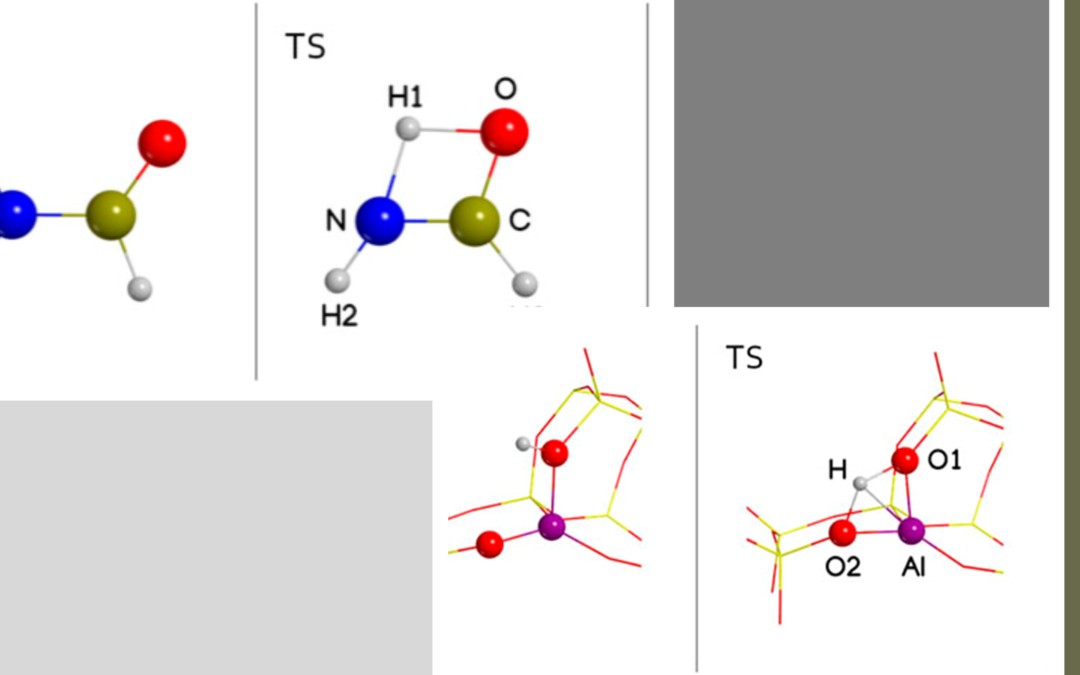
The nudged elastic band (NEB) method is a widely used algorithm for determining minimum energy paths and transition states in chemical reactions and phase transitions. In this work, we present the implementation of different NEB algorithm schemes in the CRYSTAL code, a quantum mechanical ab initio program for the calculation of electronic properties of condensed matter systems, based on Hartree–Fock and density functional theory. The use of a set of localized Gaussian-type functions to expand the wavefunction permits a very efficient evaluation of the exact exchange series for the hybrid exchange–correlation functionals. Therefore, our implementation allows an accurate characterization of transition states in both molecular and condensed phase systems, at the hybrid functional level of theory. The theoretical framework, including the force projection scheme, tangent estimation, optimization strategies, as well as the extensions of the method with climbing image and variable spring constants variants, is recalled. Then, the NEB algorithm is validated through a series of benchmark tests: two molecular reactions (a collinear proton transfer process and the keto-enol tautomerization in formamide) and a proton exchange process in a periodic chabazite zeolite. Our results are in excellent agreement with experimental and previous theoretical data, confirming the accuracy and applicability of the implementation. This work opens the possibility for future studies of complex reactive processes on extended periodic systems, using hybrid functionals.
This work has been published in The Journal of Chemical Physics.
Link to the article in J. Chem. Phys. as gold open access: https://doi.org/10.1063/5.0309524