
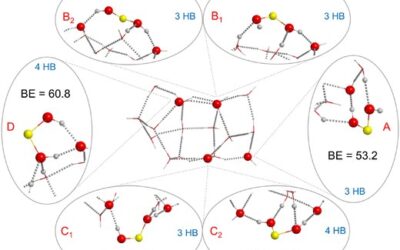
Quantum mechanical investigation on the formation of silicate building blocks on interstellar ice mantles
Quantum chemical calculations reveal water ice mantles on interstellar grains catalyze the formation of orthosilicic acid (Si(OH)₄) from SiO, providing a low-temperature pathway for silicate dust formation in dense clouds.
leer más…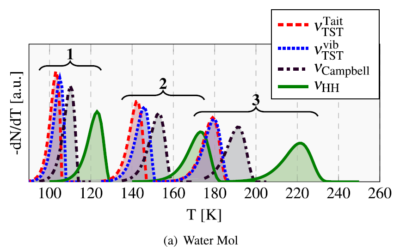
The role of the pre-exponential factor on temperature programmed desorption spectra: A computational study of frozen species on interstellar icy grain mantles
Computational comparisons of pre-exponential factor models for desorption from ices recommend using the approaches by Tait and Campbell, which provide consistent temperature predictions based on tabulated data while offering a cost-effective strategy for including vibrational contributions when necessary.
leer más…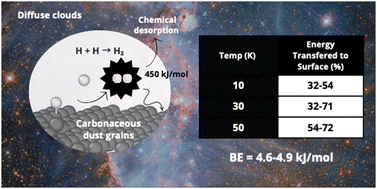
Energy partitioning in H2 formation on interstellar carbonaceous grains. Insights from ab initio molecular dynamics simulations
Ab initio molecular dynamics simulations reveal a graphene model of carbonaceous dust grains absorbs only part of the energy from H₂ formation, leaving the new molecule with enough internal energy to undergo chemical desorption in diffuse interstellar clouds.
leer más…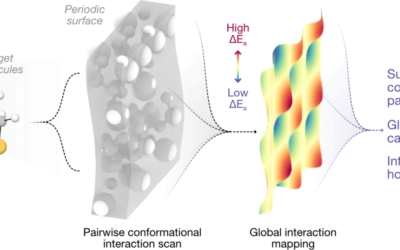
Mapping adsorption on ionic surfaces via a pairwise potential-based high-throughput approach
Efficient automated method using pairwise potentials predicts adsorption sites and energies on ionic surfaces, validated by comparisons to DFT for systems like formaldehyde on forsterite, enabling the rapid exploration of complex surfaces for catalysis and prebiotic chemistry.
leer más…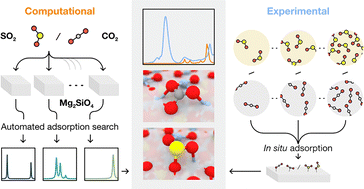
Revealing SO2 and CO2 adsorption features on forsterite via IR spectroscopy and automated computational approaches
combining experimental infrared spectroscopy with automated DFT calculations successfully models the adsorption of CO₂ and SO₂ on forsterite dust grains, identifying specific physisorbed and chemisorbed configurations that explain observed spectral features and inform interstellar chemistry.
leer más…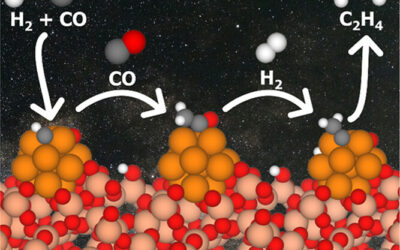
Comprehensive Atomistic Simulations of Fischer–Tropsch in Outer Space: Astrocatalysis by Fe13–Supported Nanoclusters on SiO2
A realistic computational model demonstrates that silica-supported iron nanoclusters can act as effective astrocatalysts for Fischer–Tropsch-type reactions in space, enabling the formation of methanol, ethanol, and hydrocarbons at temperatures above 100 K by facilitating CO dissociation with the aid of hydrogen.
leer más…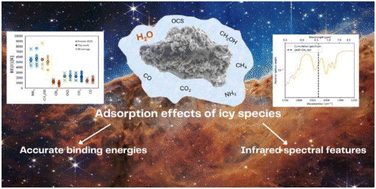
Predicting accurate binding energies and vibrational spectroscopic features of interstellar icy species. A quantum mechanical study
Quantum chemical calculations provide accurate binding energies and simulated infrared spectra for key molecules (like CO, CO₂, CH₃OH) adsorbed on water ice, serving as crucial reference data for interpreting observations from telescopes like JWST and understanding interstellar ice chemistry.
leer más…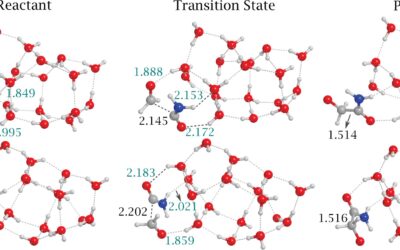
Formation of the glycine isomer glycolamide (NH2C(O)CH2OH) on the surfaces of interstellar ice grains: Insights from atomistic simulations
Computational studies reveal the formation of the detected interstellar molecule syn-glycolamide is feasible on icy grains through the low-barrier coupling of formamide and formaldehyde radicals followed by hydrogenation, with the anti-to-syn isomerization likely occurring upon desorption.
leer más…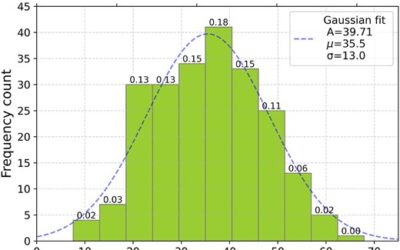
Gaseous methanol in cold environments: is thermal desorption from low binding energy sites the explanation?
The binding energy distribution of methanol on interstellar ice grains, particularly a low-energy fraction (ca. 2%, 10 kJ mol⁻¹), enables its thermal desorption into the gas phase even in cold cosmic environments, resolving a long-standing observational challenge.
leer más…
Hot Sulfur on the Rocks: The Reaction of Electronically Excited Sulfur Atoms with Water in an Ice-Surface Model
Theoretical simulations of the reaction of excited atomic sulfur (¹D) with water on an 18-molecule ice cluster reveal that the ice environment stabilizes novel products (H₂OS and HOSH) by dissipating energy and altering reaction pathways, demonstrating that gas-phase reaction models are insufficient for interstellar ice chemistry.
leer más…